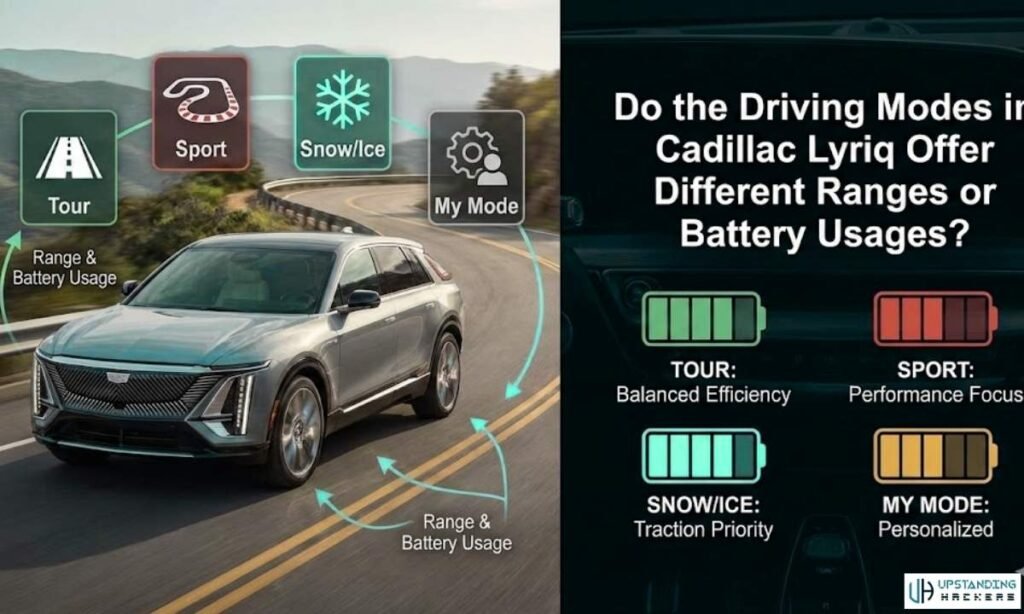

The Cadillac Lyriq offers multiple driving modes that influence both range and battery usage. Each mode adjusts power delivery, throttle response, and regenerative braking to suit different driving conditions. On a related note, The Trend of dh58goh9.7 Software and Its Growing Influence adds useful context
How Cadillac Lyriq Driving Modes Affect Energy Consumption
The Cadillac Lyriq features three primary driving modes: Tour, Sport, and Snow. Each mode is engineered to balance performance with efficiency. Tour mode prioritizes energy conservation by softening throttle input and maximizing regenerative braking. This setting is ideal for highway cruising and daily commutes where range preservation is key. Public records covering this story are gathered in Driving
Sport mode increases power output and sharpens acceleration response. It reduces the emphasis on energy recovery, favoring dynamic performance over efficiency. Drivers may notice quicker battery depletion in this mode, especially during frequent acceleration. Snow mode adjusts traction control and throttle sensitivity for low-grip conditions. While not directly tied to range, it ensures stable power delivery on slippery surfaces.
According to Cadillac’s official specifications, the Lyriq’s dual-motor all-wheel-drive variant delivers an EPA-estimated range of up to 307 miles on a full charge. However, real-world range varies based on driving behavior, climate, and selected mode. Independent tests suggest that consistent use of Sport mode can reduce effective range by 10–15% compared to Tour mode under similar conditions. Public records covering this story are gathered in Do the Driving Modes in the Cadillac Lyriq Offer Different Ranges or …
The vehicle’s 102 kWh Ultium battery pack supports intelligent energy management. The system continuously monitors driving patterns and adjusts power distribution accordingly. For example, in Tour mode, the car may limit top speed and reduce HVAC energy draw to extend range. These adjustments are automatic and require no driver input beyond selecting the mode.
Regenerative Braking and Its Role in Battery Usage
Regenerative braking plays a significant role in how driving modes affect battery usage. In Tour mode, the Lyriq enables one-pedal driving with strong regen, recapturing more energy during deceleration. This can improve overall efficiency, especially in stop-and-go traffic. Sport mode reduces regen intensity to allow for more traditional coasting, which some drivers prefer for performance driving.
The difference in energy recovery between modes is measurable. During city driving, Tour mode can recover up to 20% more energy through braking compared to Sport. This directly translates to longer range in urban environments. However, on open highways with minimal braking, the difference narrows significantly.
Cadillac also allows drivers to customize regen levels independently of driving mode. This flexibility lets users tailor efficiency to their preferences. For instance, a driver could select Sport mode for responsive handling while maintaining high regen for better energy recovery.
What Is Confirmed and What Remains Unverified
Cadillac’s technical documentation supports these functional differences. Real-world testing by automotive reviewers has consistently shown reduced range in Sport mode compared to Tour.
However, exact percentage differences in battery usage across modes are not officially published. While third-party tests suggest a 10–15% range reduction in Sport mode, these figures depend on driving style, terrain, and climate. No standardized test currently isolates mode impact from other variables.
Additionally, the long-term effect of frequent Sport mode use on battery health remains unclear. While modern lithium-ion batteries are designed for varied usage, sustained high discharge rates could influence degradation over time. Cadillac has not released data on mode-specific battery wear.
Another unverified aspect is how frequently drivers actually switch modes. Most owners may default to Tour for daily use, reserving Sport for occasional spirited driving. If true, the real-world impact on overall range may be minimal for the average user.
Why Driving Mode Choice Matters for EV Owners
Understanding how driving modes affect range and battery usage helps owners maximize efficiency. For long-distance travel or areas with sparse charging infrastructure, selecting Tour mode can make the difference between reaching a destination or needing an unscheduled charge.
Mode selection also supports sustainable driving habits. By choosing efficiency-focused settings, drivers reduce energy consumption and lower their environmental footprint. This is especially relevant as electric grids increasingly rely on renewable sources.
Looking ahead, future software updates could refine mode behavior based on real-time data. Cadillac may introduce adaptive modes that automatically adjust based on route, traffic, and battery level. Such features would further optimize the balance between performance and range.
For now, the Cadillac Lyriq’s driving modes offer tangible differences in range and battery usage. While the impact varies by driving conditions, informed mode selection remains a practical tool for extending electric range.