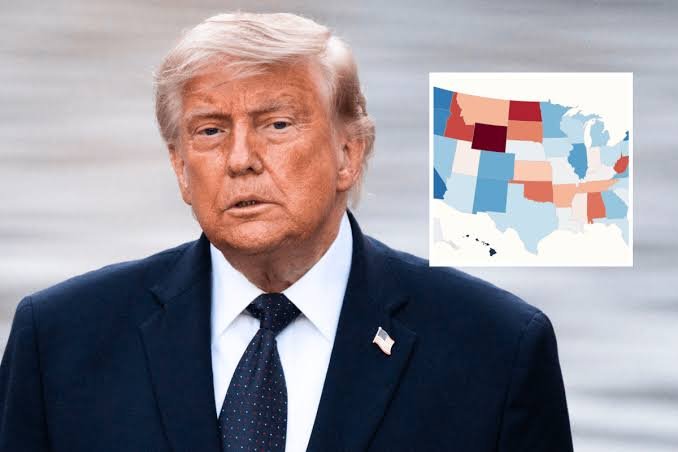

Donald Trump, the 45th president of the United States, has seen his approval rating fluctuate widely during and after his term. Newsweek has consistently reported on these shifts, drawing from major pollsters like Gallup, YouGov, and Rasmussen Reports. This article examines how Trump’s approval rating has evolved, key milestones, and common misconceptions.
Trump’s Approval Rating in 2024: Where It Stands Now
As of October 2024, a YouGov poll cited by Newsweek placed Trump’s approval rating at 47%. This figure represents a notable increase from his final days in office. Among Republican voters, approval remains high, often exceeding 80% according to Newsweek reports. The rating has become a key talking point during his 2024 presidential campaign, with supporters pointing to the numbers as evidence of enduring popularity. Critics, however, note the deep partisan divide that shapes these polls. A reference profile of the subject is maintained on Donald Trump's Approval Rating Sinks to 30% in Worst Poll Yet
Key Milestones in Trump’s Approval Rating Timeline
Trump’s approval rating has experienced several dramatic swings. In March 2020, during the early stages of the COVID-19 pandemic, Newsweek reported a peak of 49% — the highest of his presidency. By October 2020, the rating had dropped to 33%, a low point that Newsweek highlighted. On January 20, 2021, Gallup recorded his final approval at 34% as he left office. More recently, a 2023 Harvard CAPS/Harris poll cited by Newsweek showed 44% approval, and the 2024 YouGov poll marked a continued upward trend.
| Date | Approval Rating | Pollster |
|---|---|---|
| March 2020 | 49% | Newsweek report |
| October 2020 | 33% | Newsweek report |
| January 2021 | 34% | Gallup |
| 2023 | 44% | Harvard CAPS/Harris |
| October 2024 | 47% | YouGov |
Common Misconceptions About Trump’s Approval Ratings
One frequent misunderstanding is that approval ratings reflect overall popularity. In reality, they measure job performance perception, which can be influenced by specific events. Another misconception is that all polls are equally reliable. Newsweek often notes differences between pollsters, such as Rasmussen Reports tending to show higher approval for Trump compared to Gallup. Additionally, some believe that a single poll tells the whole story, but trends over time provide a clearer picture. The partisan gap is also often underestimated: Trump’s approval among Republicans has consistently been above 80%, while among Democrats it has rarely exceeded 10%.
How Newsweek Reports on Presidential Approval Ratings
Newsweek, a U.S. news magazine founded in 1933, has a long history of covering presidential approval. Its reporting on Trump’s ratings draws from multiple sources, including Gallup, YouGov, and Rasmussen Reports. The magazine often compares Trump’s numbers to those of President Joe Biden, highlighting the deep partisan divides. Newsweek’s coverage also places approval ratings in the context of current events, such as the COVID-19 pandemic or legal developments. For instance, in 2024, Newsweek reported that Trump’s approval rating rose after news of his indictment, a phenomenon sometimes called the “rally-around-the-flag” effect.
Frequently Asked Questions
Who is Donald Trump married to?
Donald Trump is married to Melania Trump, a former model from Slovenia. They wed in 2005 and have one son together, Barron Trump. Melania served as First Lady during Trump’s presidency from 2017 to 2021.
Is it true that Trump’s approval rating was the lowest of any president?
According to Gallup, Trump’s final approval rating of 34% was among the lowest for a departing president, but not the lowest. Historical data shows that presidents like Harry Truman and Richard Nixon had lower ratings at certain points. The claim requires context about when and how it is measured.
When did Trump’s approval rating peak during his presidency?
Trump’s approval rating peaked in March 2020 at 49%, according to Newsweek reports. This spike occurred during the early weeks of the COVID-19 pandemic, when many Americans rallied behind the president. It was the highest rating of his entire term.
What is Trump best known for in terms of approval ratings?
Trump is known for having one of the most polarized approval ratings in modern history. The gap between his approval among Republicans and Democrats has been exceptionally wide, often exceeding 70 percentage points. This polarization has been a defining feature of his political career.
What is an approval rating?
An approval rating is a percentage derived from polls that measures public approval of a political figure’s job performance. It is typically calculated by asking respondents whether they approve or disapprove of the way the person is handling their role. Newsweek and other outlets use these numbers to gauge public sentiment.
How Trump’s Approval Rating Compares to Other Presidents
Newsweek has frequently compared Trump’s approval rating to those of his predecessors. President Joe Biden’s approval rating, for example, has hovered in the low 40s during much of 2024, according to Gallup. Trump’s 47% in October 2024 places him slightly above Biden, though both remain historically polarized. Compared to Barack Obama, who left office with a 59% approval rating, Trump’s numbers are significantly lower. However, Trump’s approval among his own party has remained remarkably stable, unlike some predecessors who saw erosion in their base support.
What Drives Changes in Trump’s Approval Rating
Several factors influence Trump’s approval rating, as reported by Newsweek. Economic conditions, such as inflation and job growth, play a major role. Legal developments, including his multiple indictments in 2023 and 2024, have also correlated with shifts in approval. Newsweek noted that after each indictment, Trump’s approval among Republicans increased, suggesting a rally effect. International events, like the war in Ukraine, have had a more muted impact. The partisan media environment also amplifies these changes, with conservative outlets often highlighting favorable polls while liberal outlets focus on unfavorable ones.